Predicting when a jet engine will fail.
Hybrid and Deep Learning Architectures for Predictive Maintenance: Evaluating LSTM, and Attention-Based LSTM–XGBoost on Turbofan Engine RUL
11.67 → 10.53 cycles
15.48 → 14.22 cycles
23.37 → 21.64 cycles
31.65 → 29.88 cycles
Accurate prediction of a machine's Remaining Useful Life (RUL) underpins modern, cost-effective predictive-maintenance programmes. This paper proposes a two-stage hybrid pipeline that couples sequence learning with tree-based residual modelling. In stage 1, 50-cycle windows of NASA C-MAPSS sensor data (FD001 and FD004 subsets) are processed by a bi-layer Long Short-Term Memory (LSTM) network equipped with an attention mechanism; attention weights highlight degradation-relevant time steps and yield a compact, interpretable context vector. In stage 2, this vector is concatenated with four statistical descriptors (mean, standard deviation, minimum, maximum) of each window and passed to an extreme gradient-boosted decision-tree regressor (XGBoost) tuned via grid search. Identical preprocessing and early-stopping schedules are applied to a baseline LSTM for fair comparison.
The attention-LSTM–XGBoost model lowers Mean Absolute Error (MAE) by 9.8% on FD001 and 7.4% on the more challenging FD004, and reduces Root Mean Squared Error (RMSE) by 8.1% and 5.6%, respectively, relative to the baseline. Gains on FD004 demonstrate robustness to multiple fault modes and six operating regimes. By combining temporal attention with gradient-boosted residual fitting, the proposed architecture delivers state-of-the-art accuracy while retaining feature-level interpretability—an asset for safety-critical maintenance planning.
Two stages: learn the sequence,
then boost the residuals.
An attention-equipped LSTM reads each 50-cycle window of sensor data and compresses it into a context vector. That vector, plus four summary statistics of the window, is handed to a tuned XGBoost regressor that makes the final RUL call.
Sensor window
50 timesteps × 7 features, Min–Max scaled to [0, 1].
Stacked LSTM
Two LSTM layers returning full sequences, so attention can see every step.
Temporal attention
Soft weights pick out the degradation-relevant timesteps.
Context + statistics
Learned features concatenated with per-window descriptors.
XGBoost → RUL
Grid-searched gradient-boosted trees output remaining cycles.
NASA C-MAPSS: engines run to failure.
The C-MAPSS dataset, developed by NASA's Prognostics Center of Excellence, simulates the degradation of aircraft turbofan engines under varying operating conditions and fault modes using a physics-based model. Each engine starts healthy and is simulated until failure; each row is one operational cycle, with readings from 21 sensor channels covering temperature, pressure, shaft speed, fuel flow and other system-level quantities. Faults are injected as gradual reductions in the efficiency and flow capacity of the high-pressure compressor (HPC), fan and high-pressure turbine (HPT), with sensor noise added for realism [21][22].
RUL isn't in the data directly — it's derived. If a training engine fails at cycle 200, its RUL at cycle 150 is 50. Test engines are truncated before failure, and the true RUL is provided separately, mirroring the real problem of estimating the remaining life of equipment that's still in service [21][23].
- Conditions
- 1
- Fault modes
- 1 · HPC
The baseline subset: one operating condition, one fault mode.
- Conditions
- 6
- Fault modes
- 1 · HPC
Models must generalise across varying regimes.
- Conditions
- 1
- Fault modes
- 2 · HPC, fan
Tests whether a model can separate two degradation types.
- Conditions
- 6
- Fault modes
- 2 · HPC, fan
The hardest: environmental variation and fault-type diversity together.
Input features: setting_1, setting_2, T50, Ps30, Nf, Nc, W31 — chosen for their correlation with degradation behaviour as identified in prior studies.
The hybrid wins on both subsets.
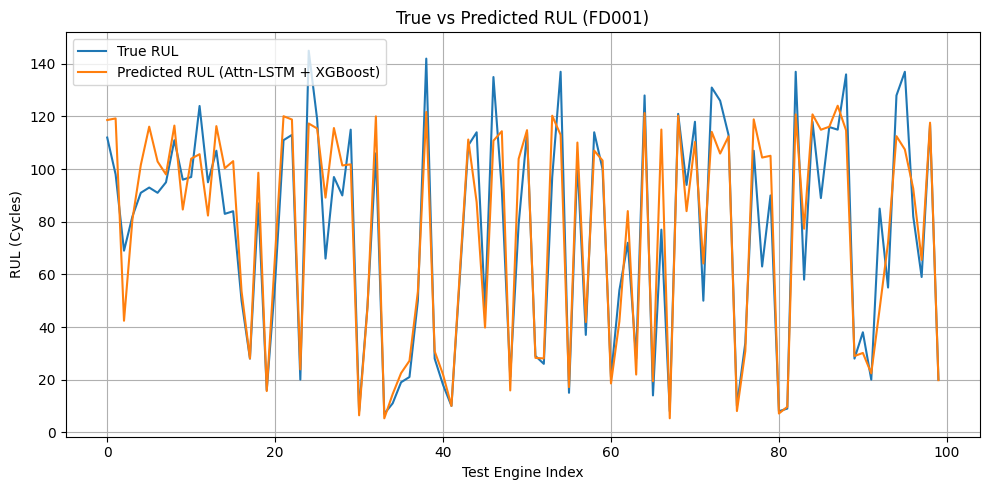
On the simpler FD001 subset — a single operating condition and a single fault mode — the attention-based LSTM–XGBoost model outperformed the baseline LSTM across all metrics.
| Model | MAE | RMSE | R² |
|---|---|---|---|
| LSTM | 11.67 | 15.48 | 86.12% |
| Attn-LSTM + XGBoost | 10.53 | 14.22 | 88.92% |
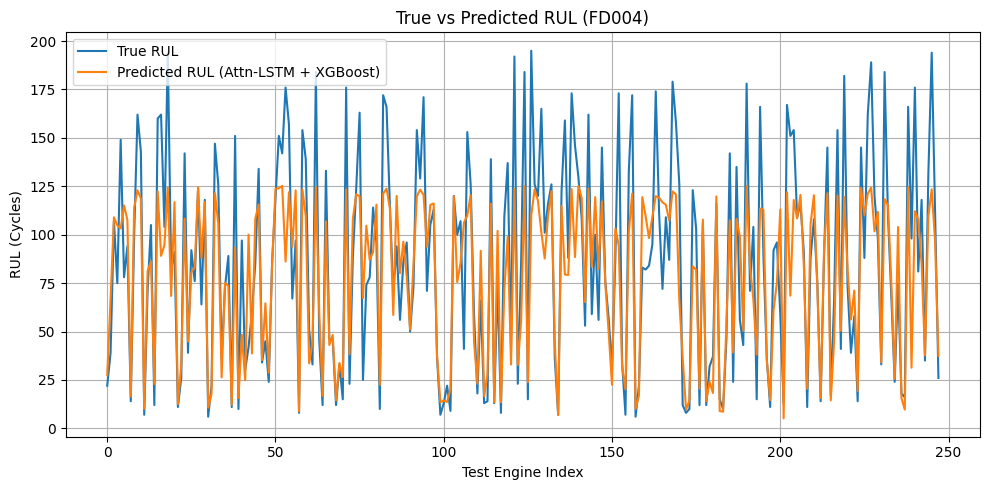
FD004, with multiple fault modes and six operating conditions, is a much harder modelling problem. Absolute errors rise for both models, but the hybrid still comes out ahead.
| Model | MAE | RMSE | R² |
|---|---|---|---|
| LSTM | 23.37 | 31.65 | 66.30% |
| Attn-LSTM + XGBoost | 21.64 | 29.88 | 69.96% |
Baseline vs hybrid, same preprocessing.
Both models see identical inputs and early-stopping schedules, so the comparison isolates the effect of attention and gradient-boosted regression.
Baseline: two-layer LSTM
LSTMs use gated memory cells to retain long-term dependencies and avoid vanishing gradients, which suits sequential degradation in sensor data. Implemented in TensorFlow/Keras:
At each timestep the cell computes its forget, input and output gates and updates its state:
Trained with the Huber loss for robustness to outliers:
Optimised with Adam, learning rate $\eta = 0.0007$:
Hybrid: attention LSTM + XGBoost
Two stacked LSTM layers return full sequences so a trainable soft-alignment attention layer can weigh every timestep:
The context vector passes through a ReLU dense layer and a linear output to produce initial RUL estimates. The best model is then converted to a feature extractor: its penultimate dense outputs are concatenated with four window statistics,
and passed to XGBoost for the final regression.
Keras Tuner · random search, 15 trials
Early stopping (patience 12) and learning-rate reduction (patience 5, factor 0.5).
XGBoost · grid search, 3-fold CV on MAE
Evaluation metrics
Four standard regression metrics give an interpretable, scale-independent comparison. With $N$ test samples, predictions $\hat{y}_i$ and ground truth $y_i$:
MAE is linear in the error and reflects typical accuracy. RMSE squares errors first, so it penalises large misses more heavily — important in safety-critical prognostics. R² is the share of variance in true RUL explained by the model; negative values mean worse than predicting the mean.
What the results mean.
Performance on FD001
MAE 10.53 and RMSE 14.22 cycles versus the baseline's 11.67 and 15.48 — reductions of about 9.8% and 8.1%. Zhao et al. (2023) reported an RMSE of 14 cycles with a 1D-conv–LSTM hybrid [33]; the paper argues the hybrid demonstrates strong extraction of critical temporal features through attention.
Performance on FD004
MAE 21.64 and RMSE 29.88 cycles versus 23.37 and 31.65 — about 7.4% and 5.6% better. Deng & Zhou (2024) reported RMSE ≈ 16.64 cycles for CNN–LSTM–Attention on FD004 [35]; the hybrid's error is higher, which the paper attributes to broader data variability.
Role of attention
Attention weights temporally significant steps, addressing the uniform treatment of the sequence in a standard LSTM. Mo et al. (2020) showed similar gains on FD004 with attention-based LSTMs [19].
Fusion with XGBoost
Adding statistical descriptors and a boosted-tree regressor improved handling of nonlinearity and noise, especially in heterogeneous conditions — consistent with prior work combining deep features with XGBoost [36].
Practical implications
A 1.7-cycle MAE improvement on FD004 is framed as roughly 25 minutes of extra warning before failure. Attention's interpretability highlights critical moments in degradation, supporting operator trust [30].
Limitations & future work
FD004 RMSE leaves room to improve on multi-regime data. Next steps: deeper attention or transformer encoders, and extending to FD002/FD003 or real field data [28][29][32].
Background, related work & references
Developments in predictive maintenance +
Predictive maintenance (PdM) is essential in aerospace systems where failures incur high safety and financial risks. The transition from reactive or preventive strategies to condition-based, data-driven maintenance enables improved reliability and reduced downtime. Central to this shift is the estimation of RUL, which empowers timely and cost-efficient maintenance planning.
Recent frameworks have explored hybrid and data-driven approaches to enhance prognostic accuracy. Berri et al. proposed a hybrid method combining a dynamical state estimator with a Support Vector Machine (SVM) classifier to monitor system health in real time, achieving ±20% error margins near end-of-life scenarios. This highlights the benefits of combining physical models with machine learning to enhance generalisability across different engines and fault modes [1].
Machine learning models such as Multilayer Perceptrons (MLPs) have been shown to effectively capture nonlinear degradation trends in engine data. Caricato et al. applied an MLP to NASA's C-MAPSS dataset, achieving RMSE and MAE of 17.38 and 12.50 respectively, validating its potential for fleet-level predictive frameworks [2].
More recent efforts have emphasised uncertainty quantification. Lee and Mitici introduced a CNN architecture with Monte Carlo dropout, generating probabilistic RUL estimates that led to a 95.6% reduction in unscheduled maintenance and a 29.3% decrease in overall cost [3]. Chen et al. integrated RUL prediction with maintenance cost modelling, optimising inspection intervals using a Maintenance Cost Rate (MCR) framework [4]. Pater and Mitici applied Sequential Monte Carlo (SMC) methods to track system health under uncertainty [5].
Uncertainty modelling remains a central challenge in AI-driven prognostics. Rastogi [6] and Xuan et al. [7] distinguish between aleatoric (data) and epistemic (model) uncertainty, emphasising the need for confidence intervals in RUL estimates to support safe, risk-aware decisions.
Traditional machine learning in industrial PdM +
Traditional ML models such as linear regression, logistic regression, Random Forests (RF) and SVMs have played foundational roles in PdM due to their low computational complexity, interpretability and ease of deployment [8], with applications across aircraft systems, semiconductor fabrication and industrial machinery.
Le et al. showed that linear regression paired with t-statistics for feature selection could maintain accuracy while reducing input dimensionality from 27 to 6 in semiconductor maintenance [9]. In aerospace, Maulana et al. proposed an explainable PdM framework using logistic regression and an Unscented Kalman Filter (UKF), achieving RMSE improvements of 34.5–55.6% over previous methods on C-MAPSS [10].
Ensemble tree methods, especially Random Forests, are resilient to noise and high-dimensional data and provide interpretable feature importance, so they're often used for benchmarking or to rank features before deep learning stages [10]. SVMs, including SVR variants, are favoured on medium-sized datasets where kernel methods uncover nonlinear degradation trends [11]. Classical techniques also support hybrid architectures — Asif et al. used moving median filters to refine input sequences before deep learning [13].
However, these models are generally limited in capturing the long-term temporal dependencies inherent in RUL prediction, and require manual feature engineering such as lags or rolling averages, reducing adaptability to complex operating conditions.
Deep learning architectures for RUL prediction +
High-frequency, multi-sensor time-series data has driven the adoption of deep learning for RUL prediction: DL models learn temporal and spatial patterns directly from raw sensor inputs, removing the need for manual feature engineering.
LSTM networks capture long-term dependencies and sequential degradation trends; Asif et al. and Wu et al. showed LSTM-based models outperform traditional approaches [12][13]. CNNs, treating time-series as structured arrays, extract local features such as gradients and short-term changes, improving early-warning capability [14][16].
Hybrids combine these strengths. Al-Dulaimi et al.'s Hybrid Deep Neural Network (LSTM–CNN) outperformed standalone models on turbofan engines under nonlinear degradation and variable conditions [14], and their CNN–Bidirectional LSTM (NBLSTM) improved stability under real-world sensor noise [15]. Zraibi et al. proposed a CNN–LSTM–DNN hybrid for lithium-ion battery RUL [16]. Wang et al. introduced a Recurrent Convolutional Neural Network with variational inference for probabilistic RUL of bearings and milling cutters [17], and a Deep Separable Convolutional Network for efficient edge deployment [18]. Mo et al. combined a multi-head CNN–LSTM with real-time error analysis [19], and Amin and Kumar tuned an LSTM/RNN/CNN hybrid with genetic algorithms [20].
C-MAPSS in prior studies +
C-MAPSS was originally created for the PHM'08 Data Challenge [22]. Its simulation model integrates nonlinear damage-progression equations and thermodynamic principles, with a system health index that declines until a failure threshold is reached.
Techniques benchmarked on it range from Random Forests and Gradient Boosting [24] to LSTMs, CNNs and CNN–LSTM hybrids [12][25]. Alomari et al. combined Random Forest, XGBoost and Natural Gradient Boosting with Genetic Algorithm and Recursive Feature Elimination feature selection, reaching RMSE of 11.8, 23.0, 14.6 and 22.3 on FD001–FD004 [24]. Thakkar and Chaoui used deep-layer RNNs with thorough preprocessing on FD001 [25]. Across studies, T50, Ps30, Nf/Nc and flow indicators (W31, W32) are commonly predictive, though optimal subsets vary [24].
Gaps remain: many studies skip simpler baselines or use non-standard preprocessing, making comparison hard, and there's no consensus on the best sensor subset or model for multi-condition, multi-fault data like FD004. This study addresses that by evaluating models under consistent preprocessing and training conditions.
Challenges in applying AI to engineering prognostics +
Data quality and preprocessing
Industrial sensor data suffers from noise, missing values and high dimensionality. Handcrafted features may not generalise across machines or fault modes [10][26], while DL models demand large, well-labelled datasets that are often unavailable [27].
Model selection and optimisation
No model is universally optimal; performance depends on dataset characteristics, fault types and operating environments [28]. DL models need careful architecture design and tuning and are prone to overfitting on limited data [29].
Interpretability and trust
In safety-critical domains, "black box" models impede human oversight. Explainable AI techniques such as feature attribution and interpretable surrogates are increasingly used to support decisions [30].
Deployment and maintenance
Concept drift degrades models over time, requiring continual learning or retraining; models must also be robust to anomalies and light enough for embedded deployment [31].
Benchmarking and dataset limitations
PdM lacks standardised benchmarks and diverse open datasets. C-MAPSS can't capture the full spectrum of real-world conditions, complicating fair comparison [32].
References (36) +
- P. Berri, M. D. Dalla Vedova, and L. Mainini, "Learning for predictions: real-time reliability assessment of aerospace systems," in AIAA Scitech 2021 Forum, 2020.
- A. Caricato, A. Ficarella, and L. S. Chiodo, "Prognostic techniques for aeroengine health assessment and remaining useful life estimation," E3S Web of Conferences, 2021.
- J. Lee and M. Mitici, "Deep reinforcement learning for predictive aircraft maintenance using probabilistic remaining-useful-life prognostics," Reliability Engineering & System Safety, vol. 218, p. 108119, 2022. doi: 10.1016/j.ress.2021.108119.
- C. Chen, J. Shi, N. Lu, Z. Zhu, and B. Jiang, "Data-driven predictive maintenance strategy considering the uncertainty in remaining useful life prediction," Neurocomputing, vol. 489, pp. 51–62, 2022. doi: 10.1016/j.neucom.2021.11.031.
- I. Pater and M. Mitici, "Model-based remaining-useful-life prognostics for aircraft cooling units," in Proc. PHM Society European Conf., vol. 6, no. 1, 2021.
- M. Rastogi, "Probabilistic method to predict remaining usage life of aircraft structures," in Proc. PHM Society European Conf., vol. 2, no. 1, 2016.
- Q. L. Xuan, Y. G. Adhisantoso, M. Munderloh, and J. Ostermann, "Uncertainty-aware remaining useful life prediction for predictive maintenance using deep learning," Procedia CIRP, vol. 112, pp. 338–343, 2023. doi: 10.1016/j.procir.2022.09.058.
- S. Elkateb, A. Métwalli, A. Shendy, and A. E. B. Abu-Elanien, "Machine learning and IoT–Based predictive maintenance approach for industrial applications," Alexandria Engineering Journal, vol. 88, pp. 298–309, 2024. doi: 10.1016/j.aej.2023.12.065.
- T. Le, M. Luo, J. Zhou, and H. L. Chan, "Predictive maintenance decision using statistical linear regression and kernel methods," in Proc. IEEE ETFA, 2014, pp. 1–6. doi: 10.1109/ETFA.2014.7005147.
- F. Maulana, A. Starr, and A. P. Ompusunggu, "Explainable data-driven method combined with Bayesian filtering for remaining useful lifetime prediction of aircraft engines using NASA CMAPSS datasets," Machines, vol. 11, no. 2, p. 163, 2023. doi: 10.3390/machines11020163.
- Q. Zhang, J. Lu, and Y. Jin, "Artificial intelligence in recommender systems," Complex & Intelligent Systems, vol. 7, pp. 439–457, 2021. doi: 10.1007/s40747-020-00212-w.
- O. Asif et al., "A deep learning model for remaining useful life prediction of aircraft turbofan engine on C-MAPSS dataset," IEEE Access, vol. 10, pp. 95425–95440, 2022. doi: 10.1109/ACCESS.2022.3203406.
- J. Wu et al., "Data-driven remaining useful life prediction via multiple sensor signals and deep long short-term memory neural network," ISA Transactions, vol. 97, pp. 305–316, 2020. doi: 10.1016/j.isatra.2019.07.004.
- A. Al-Dulaimi, S. Zabihi, A. Asif, and A. Mohammadi, "Hybrid deep neural network model for remaining useful life estimation," in Proc. IEEE ICASSP, 2019. doi: 10.1109/ICASSP.2019.8683763.
- A. Al-Dulaimi, S. Zabihi, A. Asif, and A. Mohammadi, "NBLSTM: Noisy and hybrid convolutional neural network and BLSTM-based deep architecture for remaining useful life estimation," J. Comput. Inf. Sci. Eng., vol. 20, no. 6, 2020. doi: 10.1115/1.4045491.
- B. Zraibi, C. Okar, H. Chaoui, and M. Mansouri, "Remaining useful life assessment for lithium-ion batteries using CNN-LSTM-DNN hybrid method," IEEE Trans. Veh. Technol., vol. 70, no. 4, pp. 3665–3676, 2021. doi: 10.1109/TVT.2021.3071622.
- B. Wang, Y. Lei, T. Yan, N. Li, and L. Guo, "Recurrent convolutional neural network: A new framework for remaining useful life prediction of machinery," Neurocomputing, vol. 379, pp. 117–129, 2020. doi: 10.1016/j.neucom.2019.10.064.
- B. Wang, Y. Lei, N. Li, and T. Yan, "Deep separable convolutional network for remaining useful life prediction of machinery," Measurement, vol. 147, 2019. doi: 10.1016/j.ymssp.2019.106330.
- H. Mo, F. Lucca, J. Malacarne, and G. Iacca, "Multi-head CNN-LSTM with prediction error analysis for remaining useful life prediction," in Proc. Conf. Open Innovations Assoc. FRUCT, 2020. doi: 10.23919/fruct49677.2020.9211058.
- U. Amin and K. Kumar, "Remaining useful life prediction of aircraft engines using hybrid model based on artificial intelligence techniques," in Proc. Int. Conf. Prognostics Health Manag., 2021. doi: 10.1109/ICPHM51084.2021.9486500.
- A. Saxena and K. Goebel, "Turbofan engine degradation simulation data set," NASA Ames Prognostics Data Repository, 2008.
- A. Saxena, K. Goebel, D. Simon, and N. Eklund, "Damage propagation modeling for aircraft engine run-to-failure simulation," in Proc. Int. Conf. Prognostics and Health Management (PHM), 2008.
- E. Ramasso and A. Saxena, "Review and analysis of algorithmic approaches for prognostics on CMAPSS dataset," in Proc. Annual Conf. of the PHM Society, 2014.
- Y. Alomari, M. Andó, and M. Baptista, "Advancing aircraft engine RUL predictions: An interpretable integrated approach of feature engineering and aggregated feature importance," Scientific Reports, vol. 13, 2023. doi: 10.1038/s41598-023-40315-1.
- U. Thakkar and H. Chaoui, "Remaining Useful Life Prediction of an Aircraft Turbofan Engine Using Deep Layer Recurrent Neural Networks," Actuators, vol. 11, no. 3, article 67, 2022. doi: 10.3390/act11030067.
- S. B. Lee and M. R. Hodkiewicz, "A review of data quality assessment methods for machine learning in predictive maintenance," Journal of Intelligent Manufacturing, vol. 34, pp. 2891–2909, 2023.
- Y. Pan, Z. Wang, and M. Cheng, "Challenges and trends of deep learning applications in industrial prognostics: A review," IEEE Access, vol. 8, pp. 200620–200640, 2020.
- D. Liu, Y. Lei, N. Li, and M. J. Zuo, "A review of data-driven prognostics and health management for engineering systems," IEEE Transactions on Industrial Electronics, vol. 66, no. 10, pp. 8871–8882, 2019.
- A. Ghosh, K. Goebel, and A. Saxena, "Evaluation metrics for prognostics applied to rotating machinery," IEEE Aerospace Conference, 2021.
- C. Cummins, J. Burns, and M. Keane, "Explainable AI in industrial predictive maintenance: A systematic review," Applied Sciences, vol. 14, no. 2, p. 465, 2024.
- A. Hurtado, E. Egea-López, and J. Vales-Alonso, "A survey on data-centric and model-centric approaches to concept drift in predictive maintenance," IEEE Access, vol. 11, pp. 33300–33318, 2023.
- M. Nunes, P. Ferreira, and F. Belo, "Benchmarking data-driven predictive maintenance: Challenges and future directions," Journal of Manufacturing Systems, vol. 67, pp. 302–313, 2023.
- J. Zhao, Y. Zhu, L. Gong, and Q. Zhang, "Remaining useful life prediction of turbofan engines using one-dimensional fully convolutional and LSTM hybrid networks," in Proc. IEEE Int. Conf. Prognostics Health Manag. (PHM), 2023.
- P. Khumprom, A. Davila-Frias, D. Grewell and D. Buakum, "A Hybrid Evolutionary CNN-LSTM Model for Prognostics of C-MAPSS Aircraft Dataset," 2023 Annual Reliability and Maintainability Symposium (RAMS), Orlando, FL, USA, 2023, pp. 1–8. doi: 10.1109/RAMS51473.2023.10088251.
- Y. Deng and Y. Zhou, "Prediction of Remaining Useful Life of Aero-Engines Based on CNN-LSTM-Attention," Int. J. Comput. Intell. Syst., vol. 17, no. 1, pp. 362–375, 2024. doi: 10.1007/s44196-024-00639-w.
- Y. Xu et al., "Extreme gradient boosting model has a better performance in predicting the risk of 90-day readmissions in patients with ischaemic stroke," J. Stroke Cerebrovasc. Dis., 28, 104441, 2019. doi: 10.1016/j.jstrokecerebrovasdis.2019.104441.